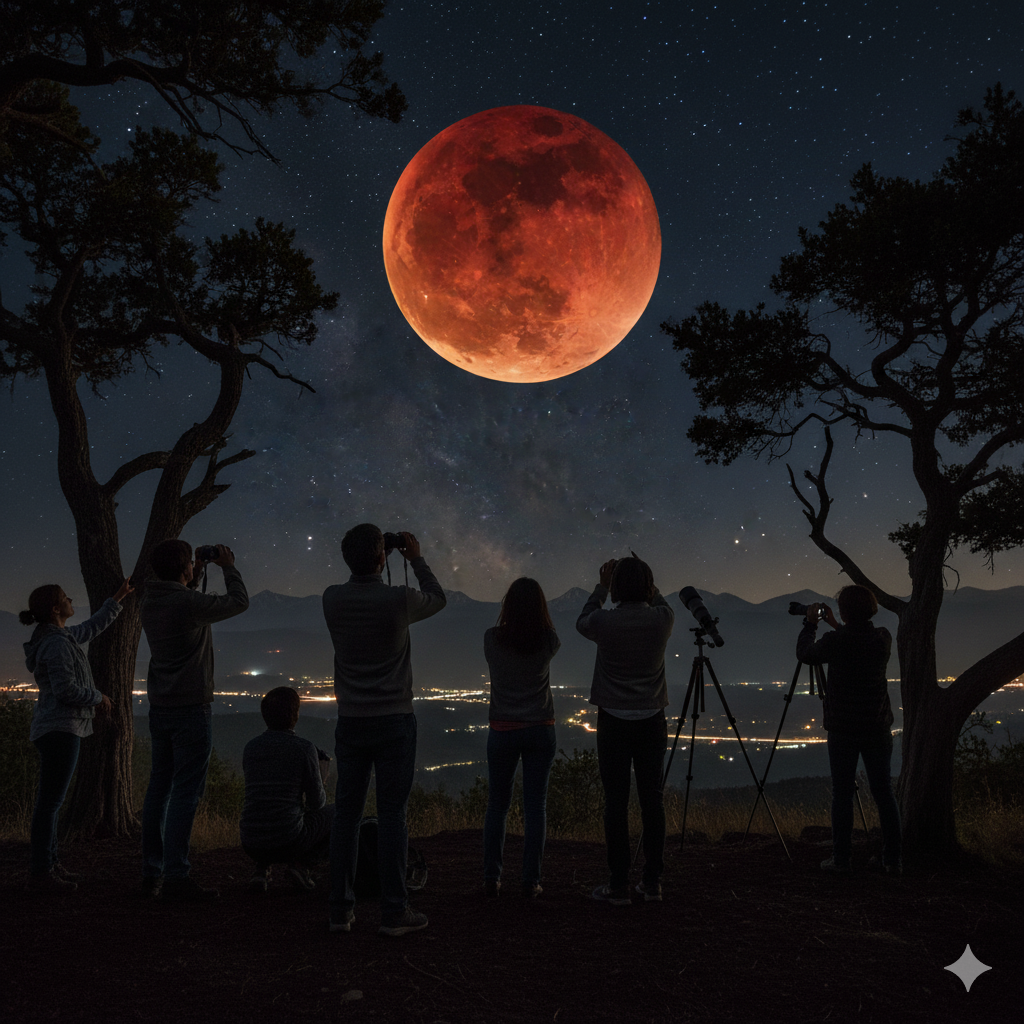
Witness the Blood Moon
Witness the Blood Moon, Are you ready for a breathtaking celestial event? A Total Lunar Eclipse, often dramatically nicknamed the Blood Moon, is one of nature’s most captivating sky shows. This awe-inspiring phenomenon occurs when the Earth positions itself directly between the Sun and the Moon, casting a shadow that turns our lunar neighbor into a deep, reddish-orange orb. Forget boring astronomy lessons; this is the real-life cosmic drama you don’t want to miss!
Witness the Blood Moon, What Exactly Is a Total Lunar Eclipse?
Let’s break it down simply. During a lunar eclipse, the Moon passes into Earth’s shadow. There are different types: penumbral, partial, and total. A total lunar eclipse is the grand finale. Here’s how it unfolds:
- Penumbral Eclipse: The Moon first enters Earth’s faint outer shadow (the penumbra). It’s usually subtle and hard to notice.
- Partial Eclipse: As the Moon moves further, it enters the darker, inner shadow (the umbra). You’ll start to see a noticeable “bite” taken out of the Moon.
- Total Eclipse (The Blood Moon): This is the main event! The entire Moon is now within the Earth’s umbra. But wait, why doesn’t it go completely dark?
The Mystery of the Blood Moon’s Red Hue
This is where the magic happens and why it’s called a Blood Moon. Even when the Moon is fully in Earth’s shadow, some sunlight still reaches it indirectly. This sunlight has to pass through Earth’s atmosphere. Our atmosphere scatters blue light more effectively (which is why the sky is blue!), allowing red and orange wavelengths to pass through and bend towards the Moon.
Imagine looking at a sunset or sunrise; the sky often appears reddish. It’s the same principle! The amount of dust, clouds, and pollution in Earth’s atmosphere can influence how red or orange the Moon appears. A truly spectacular Blood Moon often means a clearer, more dramatic red.
The Science Behind the Shadow: Umbra and Penumbra
To understand a lunar eclipse completely, you need to get familiar with Earth’s shadow. Our planet, when lit by the Sun, casts two distinct shadows.
- Umbra: This is the core of the shadow, where the Sun’s light is completely blocked. When the Moon is fully inside the umbra, we see a total lunar eclipse.
- Penumbra: This is the lighter, outer shadow. If the Moon only passes through the penumbra, it’s called a penumbral lunar eclipse. The dimming is so subtle that many people don’t even notice it.
The entire process of a total lunar eclipse—from the penumbral stage to the partial, then totality, and finally back out again—can last for several hours. The period of totality itself, when the Moon is at its most vibrant red, can last anywhere from a few minutes to over an hour.
Witness the Blood Moon, When and How to View a Lunar Eclipse
The next total lunar eclipse is predicted to occur on September 7-8, 2025. This phenomenon will be fully or partially visible in Asia, Australia, Europe, and Africa. Unfortunately, this eclipse will not be visible in the Americas.
In Indonesia, the eclipse will be visible in most regions, while in Europe and Africa, the eclipse will have already started when the Moon rises.
Unlike a solar eclipse, a Total Lunar Eclipse is perfectly safe to view with the naked eye. No special equipment is needed, although binoculars or a small telescope will enhance the experience, allowing you to see more surface detail and appreciate the rich colors.
For photographers, the Blood Moon offers a stunning subject. A few tips for capturing the moment:
- Use a Tripod: A stable camera is essential for long exposures to capture the faint light of the eclipsed Moon.
- Manual Settings: Use manual mode (M) to control your exposure. Start with a low ISO (around 100-400) and a relatively open aperture (f/8 or f/11) and adjust your shutter speed. The longer the shutter speed, the brighter the image, but too long can cause blurring.
- Manual Focus: Autofocus may struggle in low light. Switch to manual focus and focus on a distant star or the Moon’s edge.
Historical Significance and Cultural Myths
Throughout history, the Blood Moon has inspired awe, fear, and countless myths across different cultures.
- Ancient Civilizations: Many ancient cultures saw a lunar eclipse as a bad omen or a sign of a dragon or other beast devouring the Moon. The Inca believed the “blood” was caused by a jaguar attacking the Moon, a sign of its anger.
- Mesopotamia: Babylonian astronomers were skilled at predicting eclipses, but they still saw them as a threat to their king. They would often use a “substitute king” during the eclipse to divert the misfortune.
- Modern Astronomy: Today, we understand the physics behind the Blood Moon, but its visual impact remains just as powerful. It has become a symbol of celestial beauty and a popular event for amateur astronomers and the general public alike.
Final Thoughts on the Cosmic Dance
So, the next time a Blood Moon is announced, mark your calendars. It’s a cosmic ballet that inspires wonder and connects us to the vast universe around us. It’s a powerful reminder of how our solar system operates in a precise, beautiful, and predictable way. Whether you’re a seasoned astronomer or just a curious observer, this celestial event is a must-see, Witness the Blood Moon.
Don’t just hear about it; go witness the celestial spectacle yourself!
Source Code & Aset Tersedia
File konfigurasi & database tutorial ini dapat diunduh langsung secara gratis.

Related Posts

Perencanaan Strategis Sekolah: Visi Misi Tajam Lewat SWOT

Belajar Dari 0 Google Apps Script (GAS)
